
A poster series on labour, dignity and who owns a mind. Printed, then finished by hand. 2026.
I grew up inside one system that decided which people counted. I am watching a second one being built, and this time it does not need an ideology — only a metric. HUMAN DEPARTMENT borrows the language the first system used to give orders, and turns it on the second.
The posters are made the way propaganda was made: one idea, one image, one line that can be read across a room. Nothing decorative, nothing to interpret. Each work is printed at scale, then worked over by hand in the studio — acrylic, silver, stamps, strike-throughs, an inventory number — and signed and sealed. What the machine helped make, the hand finishes.
Drawn → set in type → printed → finished by hand → signed and numbered → sealed

24 × 36 in · Archival print, then finished by hand in acrylic by the artist · Edition of 5, signed, numbered and sealed
She feeds the punched ribbon into the tower with her own hands. Every hour of her work is a lesson the machine keeps.
Acquire · $5,5005 of 5 available

24 × 36 in · Archival print, then finished by hand in acrylic by the artist · Edition of 5, signed, numbered and sealed
The worker turns the wrench. Inside the machine, a human-shaped hole is being pushed out by a single bar. He is tightening the bolt that removes him.
Acquire · $5,5005 of 5 available
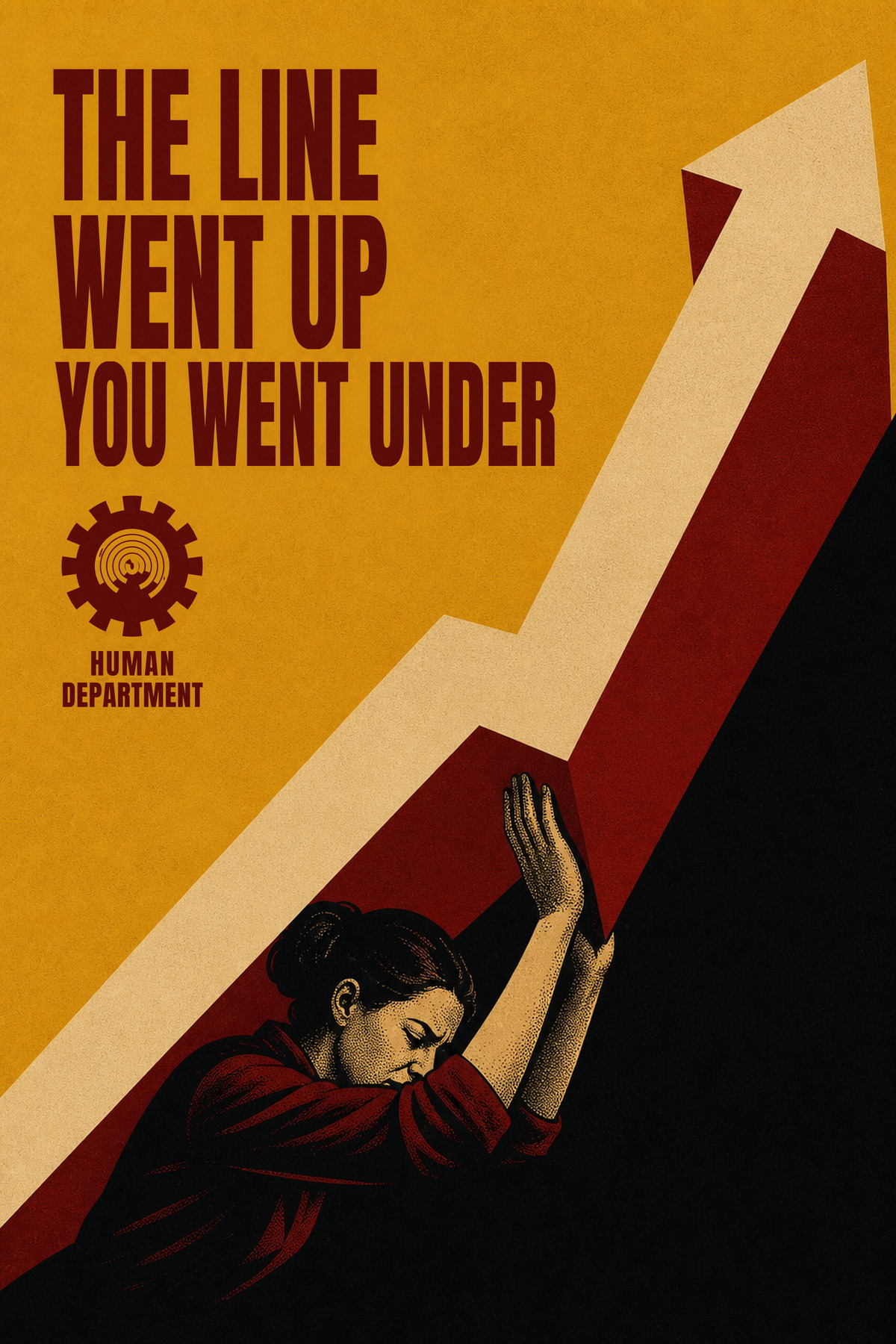
24 × 36 in · Archival print, then finished by hand in acrylic by the artist · Edition of 5, signed, numbered and sealed
The growth line is a physical object here, and it has weight. She is holding it up from underneath, which is where the results come from.
Acquire · $5,5005 of 5 available
Two sizes · both printed, finished by hand, signed and sealed
24 × 36 in · archival print, then worked over by hand in the studio — acrylic, silver, stamps, strike-throughs, an inventory number. No two impressions are the same object. Signed, numbered and sealed.
40 × 60 in · the format the series was designed for. Same hand, more of it — made to order, on 100% cotton rag with archival pigment inks, and documented for institutional acquisition.
Two artist proofs of every work are held back from sale as an institutional set, available to museums with full documentation. Editions close permanently — nothing is reprinted. Because every impression is finished by hand, each one differs from the next; that is the work, not a defect.